
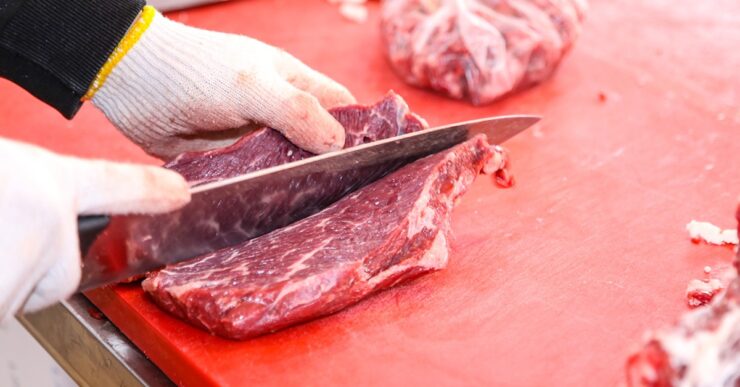
A deer hind quarter carries a lot of usable meat, including several major muscles that can be cut into steaks, roasts, jerky meat, stew meat, ground, and shanks.
Home processing lets you choose steak thickness, roast size, trim quality, and packaging style.
It can also save money, shorten wait time during hunting season, and give you more control over how the meat is handled.
Good results come from following natural muscle seams instead of cutting randomly across the whole quarter.
Ready to learn how to butcher a deer hind quarter without turning valuable hind-leg meat into random mixed cuts?
Step-by-Step Deer Hind Quarter Butchering Process
Breaking down a deer hind quarter gets easier once you stop treating it as one large piece of meat.
Focus on one seam and one muscle at a time.
Use your hands as much as your knife. Many muscles will pull apart naturally once a seam is opened.
Knife work should release connective tissue, clean tight spots, and separate meat attached to the femur.
Remove the Sirloin Tip
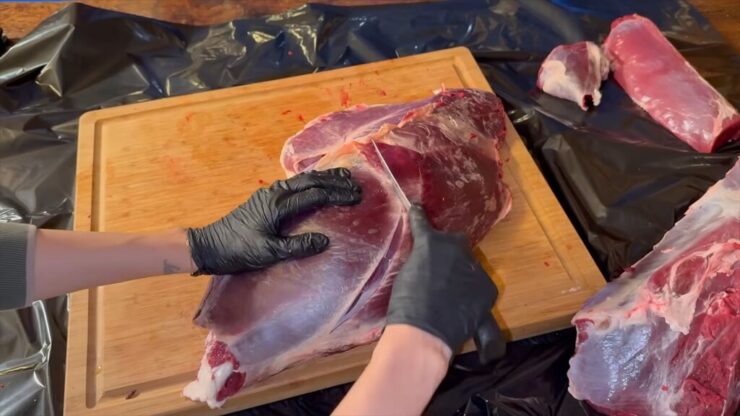
Sirloin tip sits near the front side of the femur and has a football shape. It hugs the bone and connects near the top round and bottom round.
Open the seams around the sirloin tip first. Roll the muscle away as you cut along the bone with long, steady strokes.
Keep the blade angled close to the femur so you lose less meat.
Once removed, keep the sirloin tip whole until final trimming. Its oval shape gives you several strong cooking options after deer hind quarter butchering:
- Thick steaks when sliced across the grain
- Roast when left whole
- Jerky due to its lean, even shape
- Stir-fry or fajitas when sliced thin
- Smoked meat or braised meat after careful trimming
Separate the Top Round
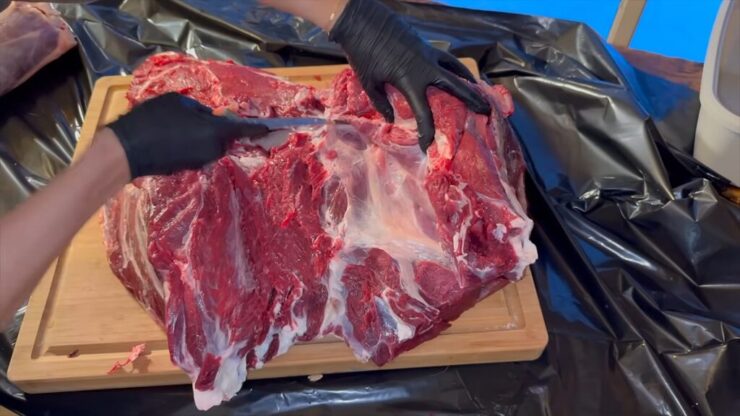
Top round sits on the inside of the deer hind quarter. It is thick, fairly tender, and easy to recognize once you see its long grain line.
Work your fingers into the seam and open the space between the top round and nearby muscles.
Use the knife only where tissue stays attached to bone or connective material.
Keep the top round intact if you want more options later. A whole top round can become steaks, medallions, roasts, stir-fry, or scallopini-style slices.
Remove the Bottom Round
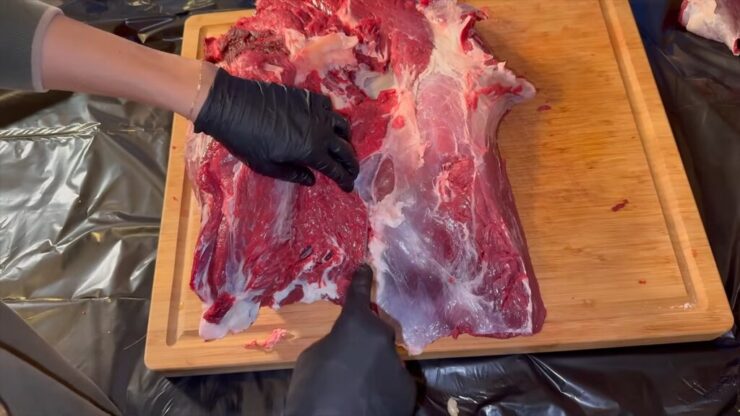
Bottom round sits on the outside of the deer hind quarter. It is long, flatter, and one of the larger muscles in the hind quarter.
Pull it away through the natural seams, then use the knife to release tight spots.
After removal, trim the thick silverskin band because it can make the finished meat chewy.
Bottom round needs cooking methods that help with leanness and texture:
- Even jerky strips cut with the grain or slightly across it
- Stew cubes cut small enough for slow cooking
- Thin steaks pounded or marinated before quick cooking
- Stir-fry strips sliced across the grain
- Cured pieces for corned venison or pastrami
- Moist roasts cooked low and slow
Pull Out the Eye of Round
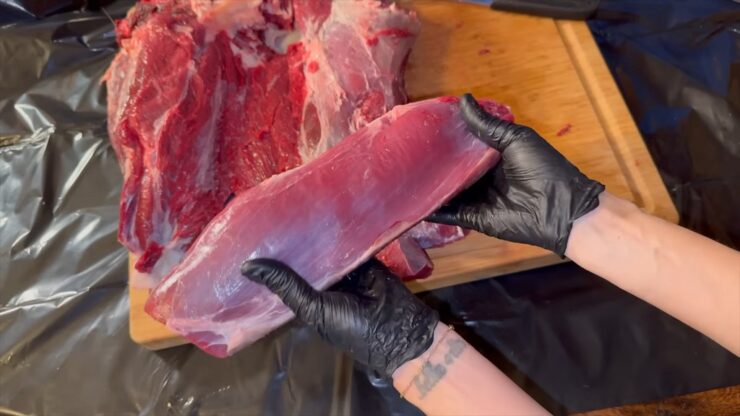
Eye of round sits between top round and bottom round. It looks similar to a small tenderloin, though it is leaner and less tender than true tenderloin.
Once located, it can often be loosened mostly by hand. Use the knife only to free tight connective tissue.
Leave eye of round whole for best control. Cook it to about 135 to 140 degrees Fahrenheit, rest it for ten minutes, then slice it thin.
Good eye of round uses include jerky, smoked deli-style meat, sandwich slices, or a small roast.
Trim the Top Sirloin, Tri-Tip, and Remaining Meat
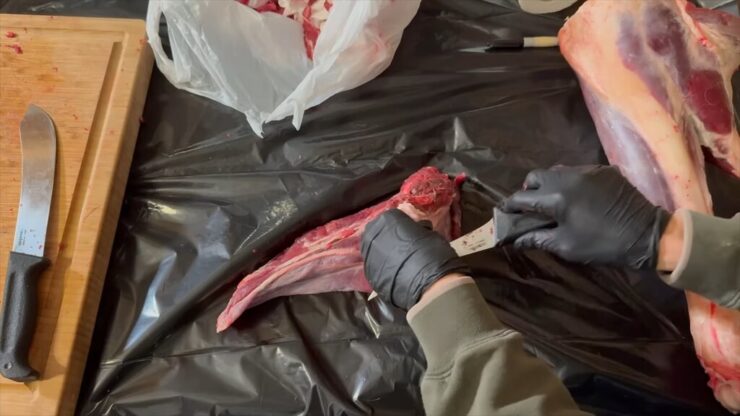
Top sirloin sits near the hip area of the deer hind quarter. Careless quartering can leave it on the carcass, so check the hip area closely during breakdown.
Trim away tough tissue and save usable pieces.
Top sirloin can become steaks, roast, stew meat, ground, burg er, or sausage. It has more connective tissue than some cuts, but careful trimming makes it useful.
Tri-tip is a small triangular piece sitting on top of the sirloin tip. Remove silverskin as needed before cooking or packaging.
Tri-tip handles several cooking styles well:
- Grilling after marinating
- Roasting whole
- Broiling with close heat
- Cutting into stew pieces
- Cubing for kabobs
Slice cooked tri-tip against the grain.
Sort the remaining clean meat by size and quality. Larger clean pieces can become stew or steak bites. Smaller clean scraps can go into the grind or the sausage.
Separate the Shank
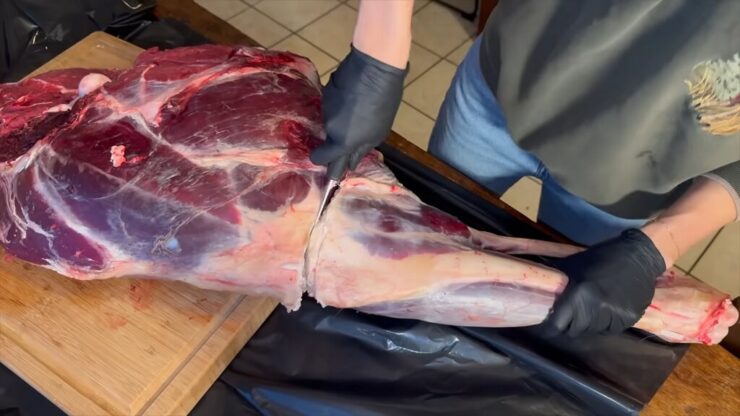
Shank sits between the knee and hoof. It contains tough muscle, tendons, and connective tissue.
Bend the knee and work the knife into the joint. Free the shin bone at the joint if removing the shank whole.
Use a meat saw if you want bone-in osso buco-style cuts.
Long cooking turns its collagen soft and gelatinous, making it ideal for braising, stew, pressure cooking, slow cooking, ragu, broth, and osso buco.
Trim and Sort the Meat
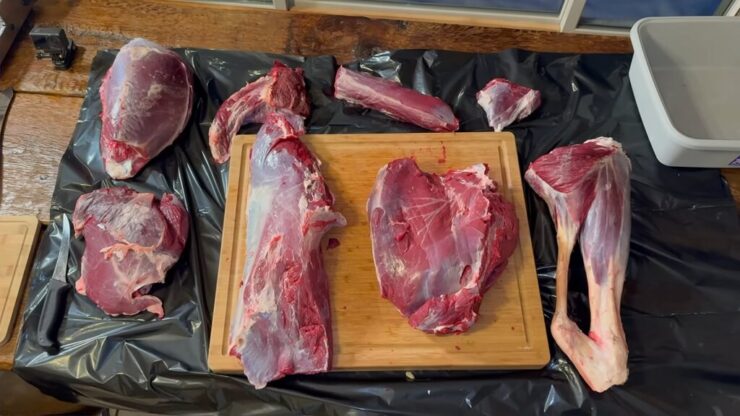
Final trimming decides how clean your packaged deer hind quarter meat will be. Removing tough tissue now saves work later and improves the way each cut cooks.
Trim away silverskin, glands, excess fat, fascia, and tough connective tissue. Keep clean scraps separate so they can become grind, sausage, stew meat, or steak bites.
Larger muscles should stay whole until you know how you want to use them.
Whole cuts give you more choices after thawing, since you can still slice steaks, jerky strips, medallions, or stew cubes later.
Pay close attention to the fat pocket between the top round and bottom round.
A lymph node can be found there, and it should not be eaten. If your blade cuts into it, wipe the knife clean before continuing.
Avoid cross-cutting the whole deer hind quarter into round steaks.
That approach mixes multiple muscles, grain directions, silverskin, and connective tissue in the same piece.
Cleaner results come by separating each major muscle first, then cutting it according to its best use.
What Tools Are Needed?
Clean tools make the job safer, faster, and easier.
A deer hind quarter is easier to break down when every cut has a purpose and every piece of meat has a clean place to go.
Gather your setup before you begin:
| Tool | Purpose |
| Sharp boning knife | Seam work, trimming, and cutting close to bone |
| Cutting board or clean table | Provides enough room for the whole quarter |
| Meat tubs or trays | Keeps sorted cuts, trim, stew meat, and grind organized |
| Paper towels | Wipes hair, moisture, and small debris |
| Vacuum sealer or freezer paper | Protects meat during long-term storage |
| Labels and marker | Marks cut names and packaging dates |
| Optional meat saw | Cuts bone-in shanks or osso buco-style pieces |
A sharp knife matters more than extra equipment. Dull blades can tear meat, make trimming harder, and increase the chance of slipping.
Clean and Prepare the Hind Quarter
Proper prep helps protect the quality of every cut you remove later.
Work with cold meat, a clean surface, and enough light to see seams, fat pockets, glands, silverskin, and dry exterior tissue.
Wipe the outside with paper towels instead of washing it.
Added water can spread loose hair and debris across the surface, while dry wiping gives you more control.
Remove anything that can hurt flavor, texture, or storage quality before breaking down the deer hind quarter:
- Hair stuck to the surface
- Dirt, debris, and bloodshot edges
- Dried rind or dried outer tissue
- Waxy fat that can carry strong flavors
- Dirty silverskin and damaged fascia
- Any questionable pieces that look contaminated
Fresh meat is usually easier to process. Longer hanging can create a thicker dried exterior, which adds trimming time and can waste usable meat.
Before making major cuts, identify the femur, hip area, knee joint, shank, and natural muscle seams.
A short look at the structure helps you cut with the deer hind quarter instead of against it.
Main Cuts of a Deer Hind Quarter
A deer hind quarter is not one single cooking cut.
It is a group of muscles with different grain direction, tenderness, connective tissue, and best uses.
Major deer hind quarter cuts include:
- Top round, also called inside round
- Bottom round, also called outside round
- Eye of round
- Sirloin tip, also called knuckle or football
- Top sirloin or rump
- Tri-tip
- Shank
Some simple breakdown methods focus on five main cuts: sirloin, bottom round, top round, eye of round, and shank.
That approach can work well for hunters who want a practical home-processing system without overcomplicating the job.
Top round can make tender steaks or roasts. Bottom round often does better as jerky, stew, or slow-cooked meat.
Sirloin tip is useful for jerky, steaks, roasts, and thin slices. Shank needs long cooking because it contains a lot of collagen.
Closing Thoughts
Butchering a deer hind quarter is easier when you keep the meat cold, clean the surface well, follow natural seams, and separate each major muscle before final trimming.
Learning how to butcher a deer hind quarter also helps you use more of the animal.
One hind quarter can produce steaks, roasts, jerky meat, stew meat, ground, sausage trim, shanks, and slow-cooking cuts.
Instead of treating the whole leg as one generic piece of meat, match each muscle to the cooking method that fits it best.